Environmental Sustainability
As a global citizen, Chenbro actively promotes a low-carbon culture within the company, dedicated to achieving the 2050 Net Zero Transition goal.

Climate Change Management
Chenbro Environmental Policy
Chenbro is committed to complying with environmental regulations to meet international standards and customer expectations while pursuing sustainable development. Recognizing that corporate operations, products, and services can impact the environment, we are dedicated to maintaining a zero-use rate of hazardous and restricted substances.
Greenhouse Gas Management
Chenbro launched a group-wide greenhouse gas (GHG) inventory initiative to accurately track its carbon emissions. In 2025, Chenbro Headquarters, the Chiayi factory, Chen-Feng Precision, Chenbro Technology (Kunshan), and Procase Electronic (Dongguan) all successfully obtained ISO 14064-1 verification statements.
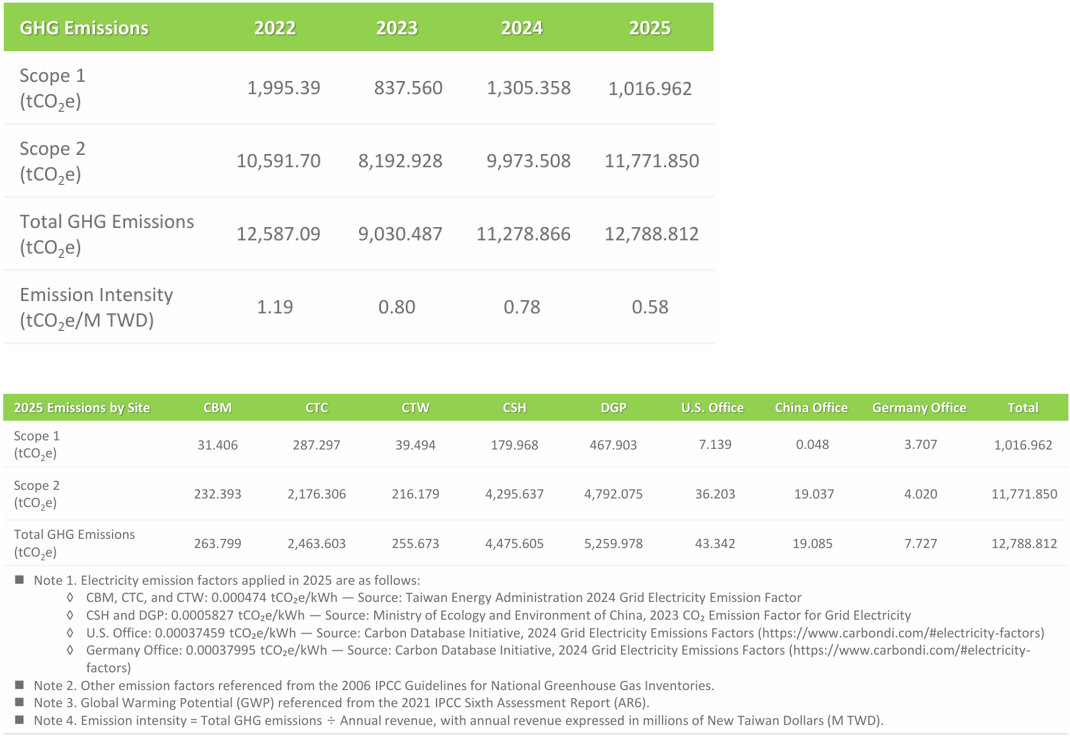
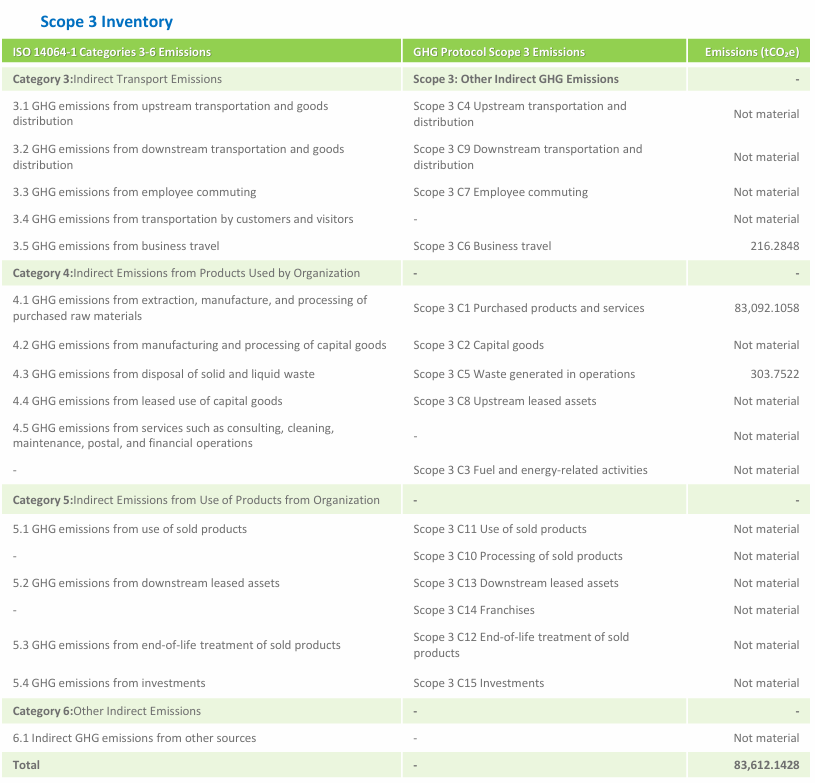
The 2025 GHG inventory boundary encompasses CBM, CTC, CSH, DGP, CTW,and the U.S., China, and Germany offices. The inventory scope covers Scope 1 (direct GHG emissions) and Scope 2 (energy indirect GHG emissions), with Scope 3 inventoried based on materiality. Greenhouse gases inventoried include carbon dioxide (CO₂), methane (CH₄), nitrous oxide (N₂O), hydrofluorocarbons (HFCs), perfluorocarbons (PFCs), sulfur hexafluoride (SF₆), and nitrogen trifluoride (NF₃), with emissions expressed in metric tons of carbon dioxide equivalent (tCO₂e).
In 2025, the Group's total GHG emissions increased slightly due to higher production capacity; however, through continued implementation of carbon emission management, emission intensity declined to 0.58 tCO₂e/M TWD,
the lowest level in the past four years. Scope 1 emissions were primarily driven by the addition of new machinery and equipment at various plants and increased output, while Scope 2 emissions rose in line with higher energy consumption resulting from increased production demand.
Energy Management
Energy Policy
As a responsible corporate citizen, Chenbro integrates energy conservation and carbon reduction into our core operational strategy while satisfying customer requirements.
We Commit To:
Fostering awareness: Cultivate energy-saving and carbon-reduction mindsets to strengthen alignment and communication across the organization.
Improving efficiency: Enhance energy efficiency and drive continuous improvement in energy performance.
Ensuring sustainability: Optimize system management and operations to achieve our long-term sustainable business goals.
Energy Consumption Overview
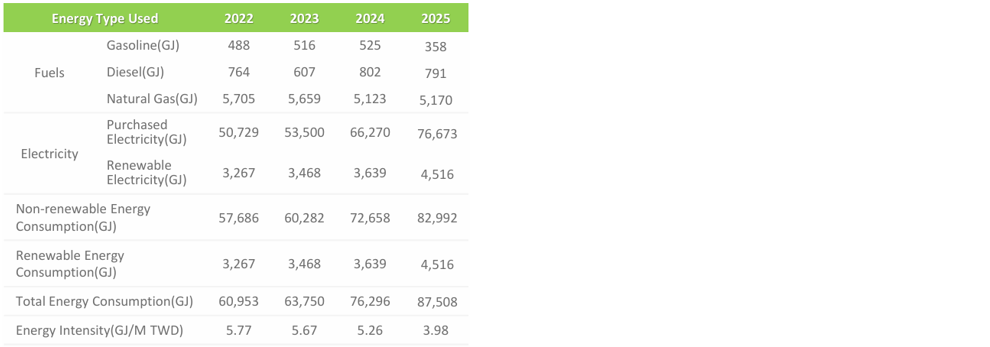
Chenbro places great importance on the impact of energy use on operating costs and environmental sustainability, continuously promoting systematic energy management operations, and was the first to introduce the ISO 50001 energy management system at CTC, continuously refining energy management practices to lay the energy management foundation for the entire Group. In recent years, the Company has continued to expand its operational scale, with over all energy consumption showing an upward trend due to business growth.
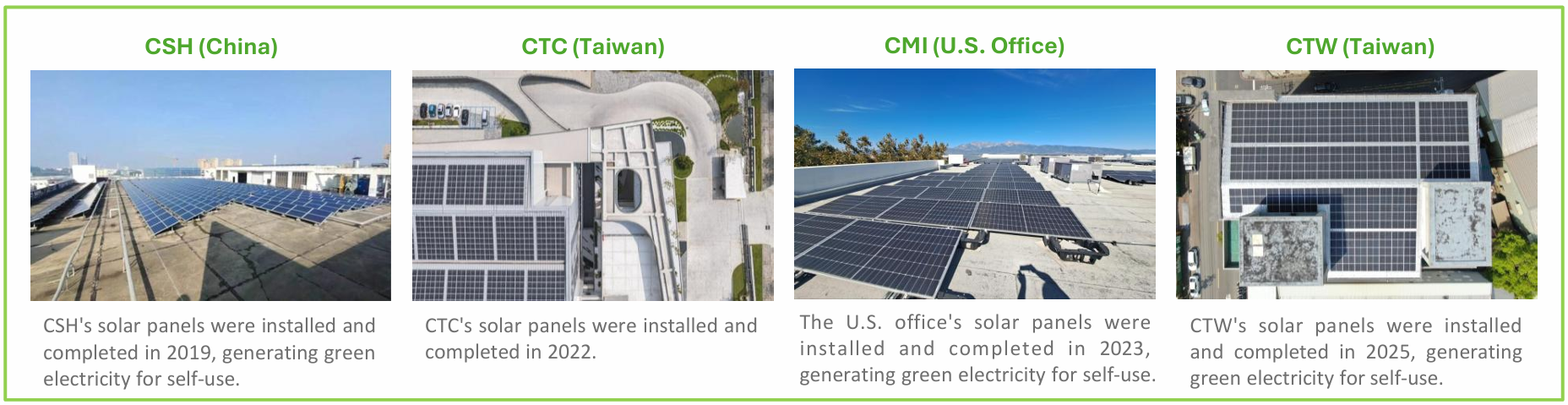
At the same time, energy-saving measures have been actively introduced at each site, and solar power self-generation and self-use system deployment has continued. As a result, the Group's energy intensity has steadily declined. In 2025, the energy intensity was 3.98, representing a significant decrease of 24.33% compared to 2024, while the proportion of renewable energy use reached 5.16%.
The Company plans to use 2030 as the target for reducing energy intensity to 3.75 by that year, and simultaneously increasing the renewable energy proportion to 2030 10% as targets for strengthening energy management, steadily advancing toward low-carbon transition and sustainable development.
The Company is committed to creating an environmentally sustainable and friendly office space. Annual plans include replacing high-energy-consuming equipment, introducing automated processes in factories to improve efficiency and reduce energy consumption; implementing air conditioning temperature and time control in offices, turning off lights during lunch breaks to save energy; and procuring LED lighting and light sensors, energy-saving inverter air conditioners, and using solar power generation. Furthermore, the Company integrates energy saving and carbon reduction concepts into daily operations and organizational culture, raising all employees' energy-saving awareness through education, training, and promotional activities, and encouraging energy-saving behaviors in office and operational environments, advancing business performance in a climate-friendly and cost-effective manner and progressively implementing this across every aspect of operations.
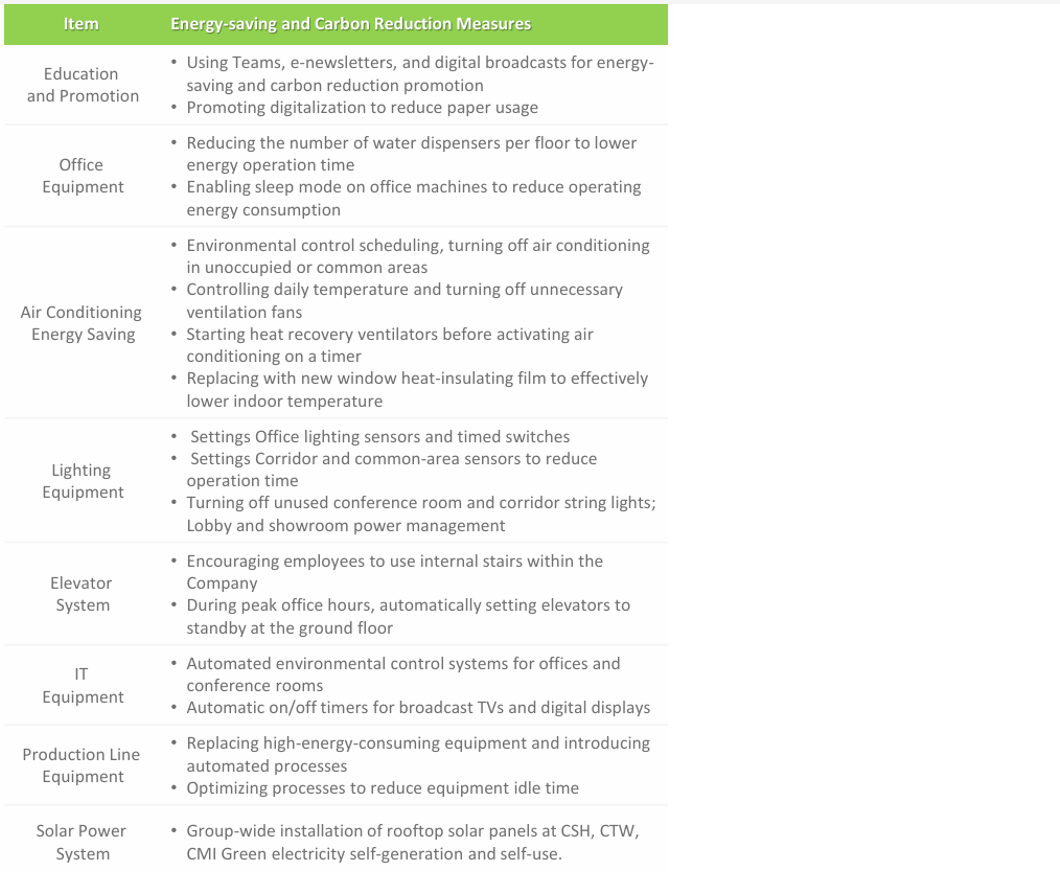
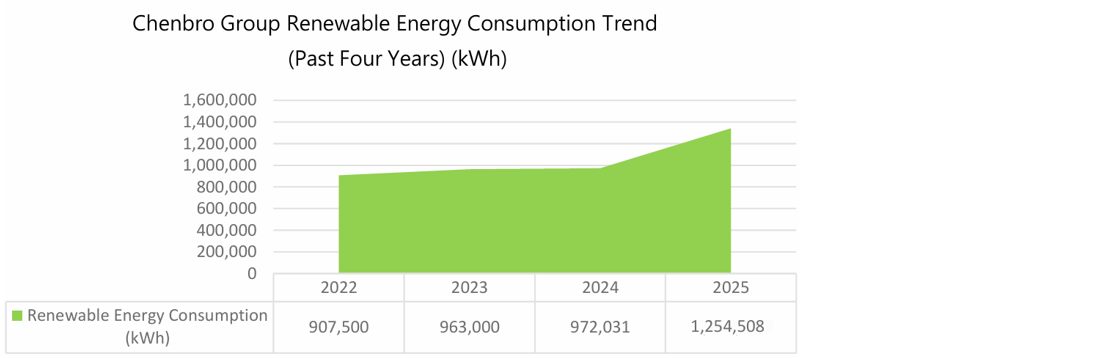
In 2025, Chenbro continues to expand its renewable energy portfolio. Renewable energy from solar power self-generation and self-use, with green electricity consumption reaching 1,254,508 kWh, a new high in recent years. Using the 2024 electricity carbon emission factor, 0.000474 tCO2e/kWh converted, the carbon reduction effect is approximately 594.64 tCO2e. The proportion of renewable energy as a percentage of total electricity consumption is 5.56%.
At the same time, renewable energy installation has been incorporated into the planning for new plants. The new Malaysia plant is expected to commence solar power generation in 2026 after officially starting operations, which will increase the Group's proportion of renewable energy use, reduce GHG emissions from operational electricity use, and further strengthen Chenbro's overall renewable energy portfolio and low-carbon operational capability.
Water Resource Management
CTC has established an ecological retention pond and waterway with a water storage capacity of 111.36 cubic meters, effectively increasing the land's moisture retention capacity and providing temporary flood detention during rainfall. The buildings have rainwater collection and reuse facilities with a capacity of approximately 1,060 cubic meters. CTC collects rainwater from rooftops and channels it into infrastructure, treating it for use in plant irrigation, combined with rain sensors to conserve irrigation water and reduce Group water consumption. In 2026, the Company plans to assess the installation of flow meters to track recycled water usage and strengthen water resource management and recycled water application efficiency.
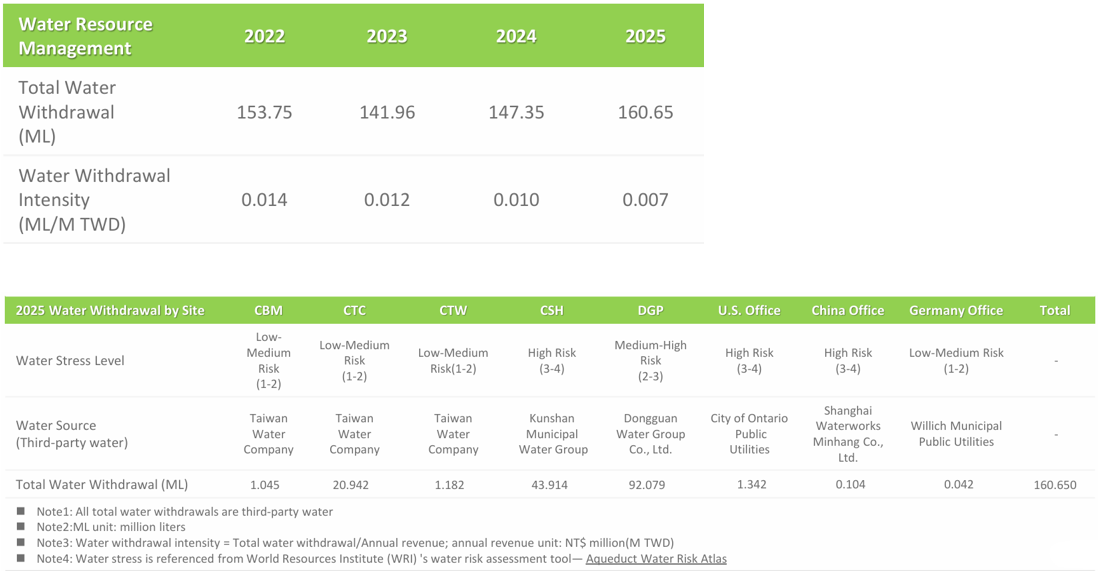
In 2025, the total water withdrawal was 160.65 million liters, with a water withdrawal intensity of 0.007, representing a decrease from the 2024 intensity of 0.010. The target is to reduce the intensity to 0.005 by 2030.
Green Products

Eco-Friendly Product Strategy
Chenbro products comply with international regulations, safety standards, and environmental regulations, and actively meet customer standards, fulfilling its green product management responsibilities.
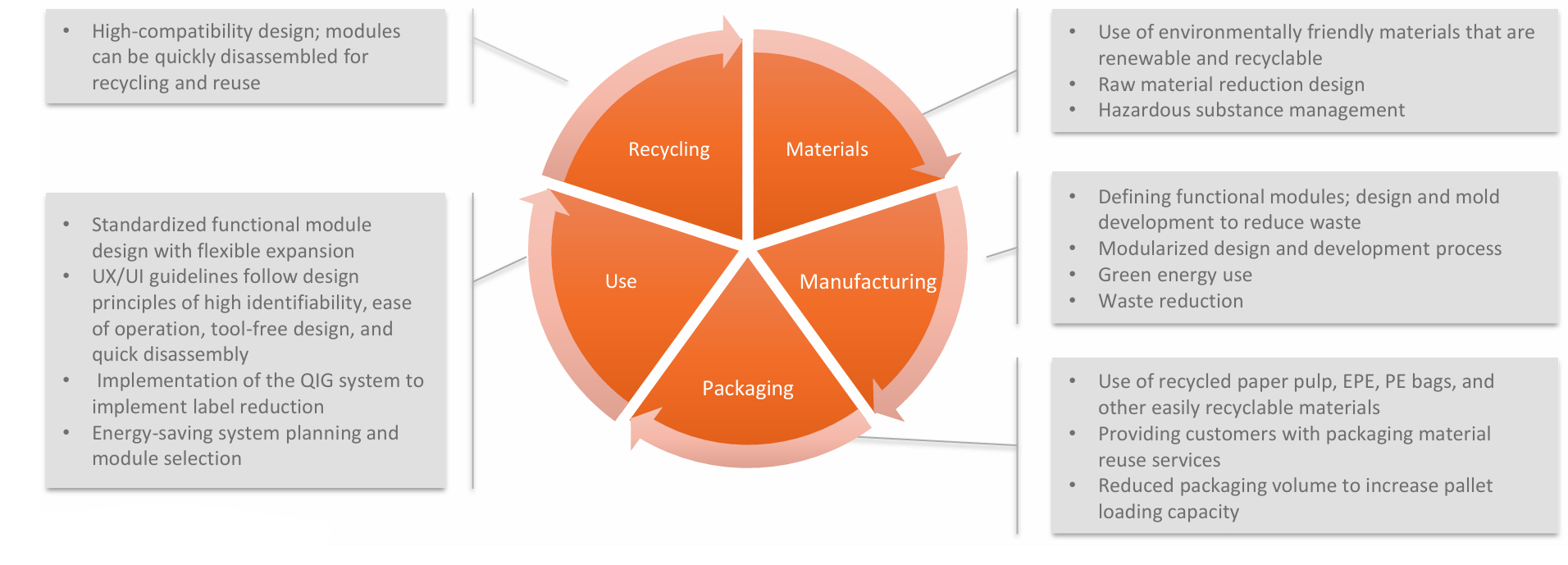
In R&D and design, the Company uses recyclable, environmentally friendly materials. In addition to implementing the environmentally friendly 3R principles, the Company is further advancing toward Cradle to Cradle (C2C) circular economy product certification goals.
The Company complies with the Waste Electrical and Electronic Equipment Directive (WEEE), designing products with goals of ease of disassembly, recyclability, and environmental friendliness, with modular product mechanical design following design guidelines of high identifiability, ease of operation, tool-free design, and quick disassembly. Modules have high compatibility and flexible expansion capability, not only simplifying processes but also improving module reuse rates.
To reduce the manufacturing process's impact on the environment, the Company has established an environmental management system, clearly defining environmental management procedures to implement control over waste and energy resource usage generated during the manufacturing process.
Waste Management
ISO 14001 Environmental Management System, EMS
Chenbro Group sites follow the ISO 14001 environmental management system to manage waste, ensuring waste flows are transparent and comply with regulations through source reduction, reuse, and management of qualified removal operators. Each plant supervises removal sites, confirming vehicle load contents, weighing verification, and the transportation process to confirm no secondary pollution, and implements disposal at disposal sites in accordance with regulations.
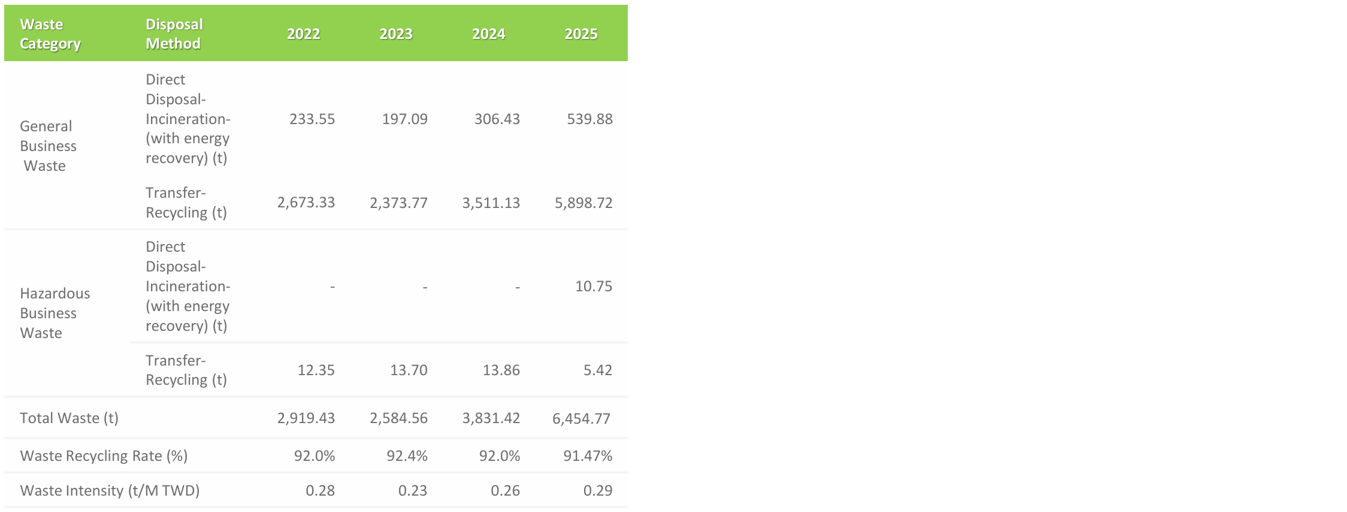
In 2025, due to simultaneous growth in Group revenue and production capacity, total waste and waste intensity per unit revenue (t/M TWD) both increased from the previous year. Total waste amounted to 6,454.77 tonnes, with waste intensity of 0.29, with a target of reducing the intensity to 0.20 by 2030.
In recent years, the plant waste recycling rate has been maintained above 90%. In 2025, it reached 91.47%, which continuously maintaining low resource consumption and environmental burden. In the future, the Company will continue to review and improve its waste management strategy, advancing toward the circular economy goals of waste reduction, low carbon, and "produce more, waste less," fulfilling the Company's commitment to environmental sustainability.
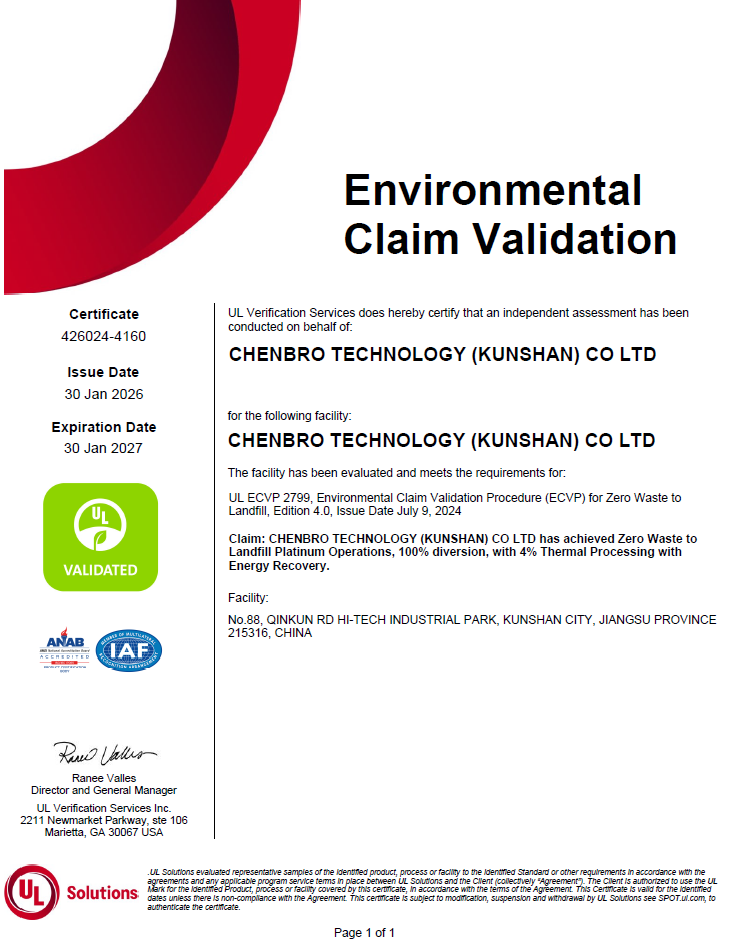
UL 2799 Zero Waste to Landfill, ZWTL
In addition to internal waste management, the Company also promotes source reduction and circular model innovation from the product and packaging design end. Previously, customers commonly used single-use cardboard boxes and wooden pallets, which not only had limited recycling efficiency but also increased labor and packaging cost burdens. To address this, the Company independently developed a "Modular Reusable Plastic Packaging" system made from recycled crushed plastic materials, with each layer composed of four detachable corner pieces that can be circularly recycled and reused.